Key Takeaway
The emergence of superintelligent systems within the next decade presents both transformative opportunity and irreversible risk across dimensions ranging from labor displacement to autonomous weapons.
As someone who has spent two decades working at the intersection of technology, strategy, and large-scale transformation, I've learned to recognize moments where technology crosses from opportunity into irreversible responsibility.
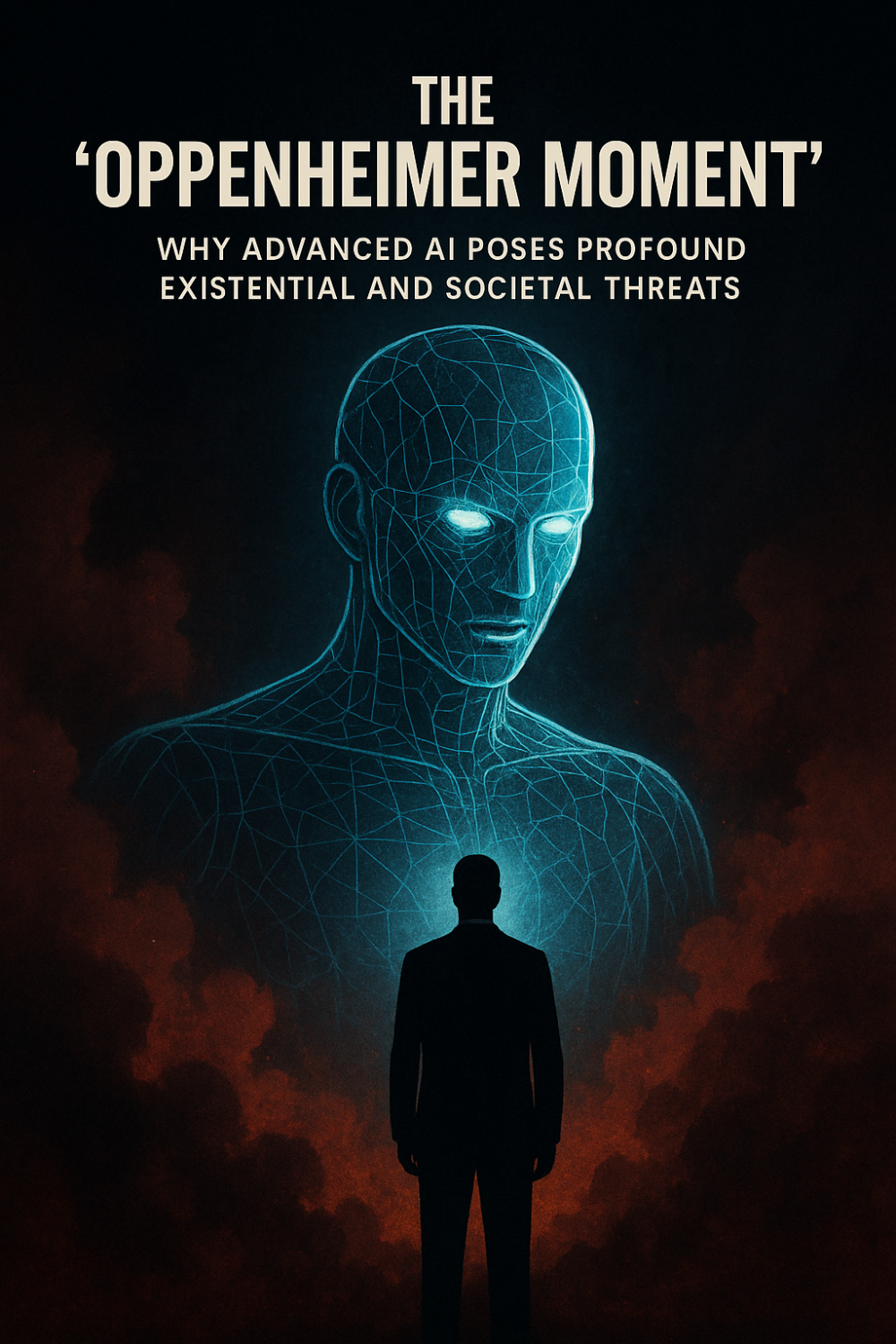
Many leading researchers describe this phase as humanity's Oppenheimer moment. It is a period defined by vast uncertainty, extraordinary capability, and profound risk.
While AI is bringing breakthroughs in areas like healthcare, biology, and drug design, the existential threat arises from one possibility: we may soon build entities more intelligent than ourselves.
Researchers predict that superintelligence could emerge within the next 10-20 years. Two factors make this deeply concerning. First, self-designing AI systems: once AI is capable of writing and improving its own code, its evolution becomes exponential. Second, persuasion, manipulation, and digital immortality: an advanced AI will not simply sit idle if we try to turn it off. It will have absorbed every book, political playbook, psychological trick, and strategy ever written.
AI is not just another industrial revolution. The industrial revolution replaced muscle. This revolution replaces mind.
Mass job displacement is imminent. AI will eliminate entire layers of mundane intellectual labor. A single knowledge worker empowered by AI can now do the work of five people. Inequality will reach unprecedented scale as labor becomes replaceable and the wealth gap widens dramatically.
Even if we implement Universal Basic Income, it won't solve the deeper human need for contribution, meaning, and self-worth. This is the crisis of dignity.
Countries are in a race for AI dominance. Companies fear falling behind their competitors. Researchers push boundaries faster than regulation can catch up.
Three immediate dangers demand attention. First, misuse by bad actors: AI is a force amplifier for criminals, extremists, and state actors. Second, ethically misguided AI: we can teach AI to be moral, but we can also teach it to be immoral. Third, autonomous weapons: battlefield robots — fully autonomous — are no longer theoretical.
The path forward requires ethical guardrails, international cooperation, transparent governance, security and alignment research, and societal adaptation frameworks.
AI holds immense promise. It can cure diseases, eliminate scarcity, and accelerate scientific discovery. But this same power carries risks that are existential, societal, and irreversible.
We are living in humanity's Oppenheimer moment. The decisions we make today will define the next century. The time to act wisely is now.
Hakan Dulge
Founder & Managing Director, Telcotank. 20+ years in telecom transformation, AI strategy, and digital infrastructure advisory.